
Traveler Health
Food Allergies in Arugam Bay: How to Communicate Them at Restaurants and Guesthouses
Nov 3, 2026 · 7 min read
Arugam Bay runs on small, open kitchens — a few gas burners, one or two cooks, a menu that changes with what came off the boat that morning. It’s part of what makes the food so good. It’s also exactly the setup that makes a food allergy harder to manage than it would be at a large restaurant back home. One wok, one set of tongs, one cutting board often serves the whole kitchen, and a dish that looks “safe” on the menu can pick up traces of shellfish, peanuts, or egg along the way.
None of this means you can’t eat well here with a serious allergy. It means you need to communicate clearly, more than once, and build in a bit of margin. Here’s how we’d approach it if it were us.
Why this is harder here than at home
Shared equipment. A small guesthouse kitchen might fry your vegetable rice in the same wok that just cooked a prawn curry, with only a rinse in between. The dish itself may contain no allergen, but the pan did.
Menu translation gaps. Many menus are written by someone’s second or third language speaker, translated loosely from Sinhala or Tamil, and reprinted without much editing. “No nuts” on a menu doesn’t always mean the kitchen checked — it sometimes means someone typed what a previous guest asked for.
Hidden ingredients. Dried Maldive fish (a fermented tuna flake) is used as a flavour base in many “vegetable” curries and sambols, even ones that look entirely plant-based. Peanuts and cashews are ground into curry pastes where they’re invisible once cooked. Shrimp paste shows up in sauces that don’t mention shrimp anywhere on the menu.
Staff turnover. Guesthouse and café kitchens here often run on seasonal staff. The person who understood your allergy last week may not be the one cooking tonight.
How to communicate your allergy clearly
Say it before you order, not while ordering. Catch a staff member’s attention, say the allergen name slowly, and wait for a nod of understanding before you point at the menu. Rushing this step is where most mistakes happen.
Use the ingredient name, not a category. “No seafood” is less precise than “no prawns, no crab, no fish, no shrimp paste” — in a kitchen where English is a second or third language, the specific word travels better than the umbrella term.
Write it down and carry it. Keep a short card or a note on your phone with your allergy written in Sinhala or Tamil as well as English. Showing it to the cook directly, not just the waiter, closes a surprising number of gaps — a lot of kitchens here are small enough that you can simply ask to speak to whoever is cooking.
Ask the direct question about cross-contact. “Is this cooked in the same pan as the prawn curry?” gets a more useful answer than “does this have prawns in it?” Many cooks will answer honestly about shared equipment once you ask the right question, even if they’d have said “no allergens” to a vaguer one.
Repeat it with every new dish and every new visit. Confirming once at the start of the meal isn’t enough if you’re ordering several dishes, and a kitchen that got it right yesterday may not remember you today.
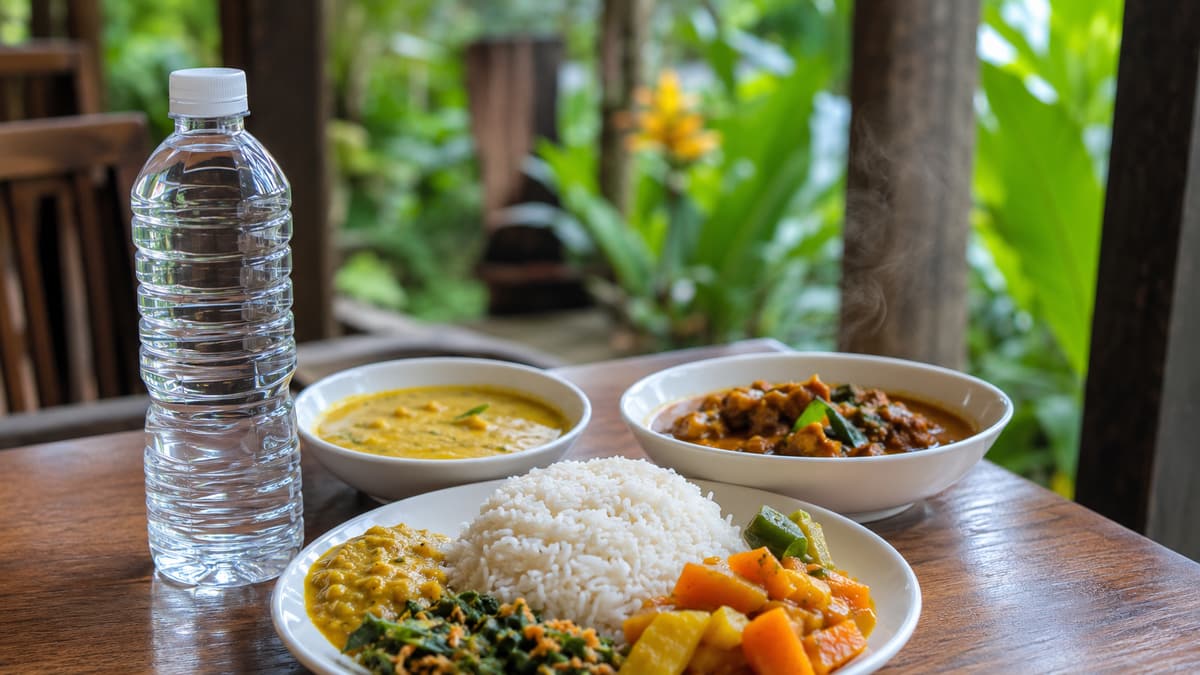
Choose simpler dishes when your allergy is severe. A plain grilled fish or dhal and rice, cooked to order, carries far less cross-contact risk than a mixed rice-and-curry spread where ten small dishes have been sitting out and sharing spoons.
A card worth carrying
If you have a genuine allergy (not just a preference), it’s worth writing out — before you arrive, or with help from your guesthouse — one clear sentence in Sinhala and Tamil script stating your allergen and that a reaction could be serious. Phone translation apps are useful for conversation, but a written card survives a noisy kitchen and a rushed moment better than a phone screen passed hand to hand.
If you carry an auto-injector
Bring it to every meal, not just the ones you think are risky — cross-contact can turn up in a dish you didn’t expect. Tell us when you register with us, even for an unrelated visit, so we have it on file. If you want a refresher on recognising a reaction early and what to do if it escalates, see our guide on allergic reactions and anaphylaxis.
If something still goes wrong
Mild symptoms — hives, lip tingling, mild stomach upset — are usually manageable with antihistamines, which we stock, along with adrenaline, steroids, and oxygen for anything more serious. If you notice swelling of the lips or tongue, difficulty breathing, or widespread hives with dizziness, use your auto-injector if you carry one and call 1990 for a free ambulance, or come straight to us — we’re open 24/7 and it’s often faster to walk or tuk-tuk in than to wait for transport in town.
We also see travelers whose stomach upset after a meal turns out to be ordinary food poisoning rather than an allergy — the symptoms can overlap in the first hour. Our guide to travelers’ diarrhea and food poisoning covers how to tell the difference.
Related reading
- Allergic Reactions & Anaphylaxis in Sri Lanka: What to Do
- Food Poisoning and Travelers’ Diarrhea: What to Do
- Pharmacy Guide: What You Can and Can’t Buy Over the Counter in Arugam Bay
This article is general health information and not a substitute for medical advice. If you have a known food allergy, carry your medication, tell kitchen staff clearly and repeatedly, and if a reaction feels serious, call 1990 or come to us immediately.
Related articles
Traveler Health
Allergic Reactions & Anaphylaxis in Sri Lanka: What to Do
New foods, new insects, new sun exposure — Sri Lanka has plenty of new allergy triggers. Here's how to spot a reaction early and what to do if it turns serious.
6 min read

Traveler Health
Altitude Sickness in Sri Lanka's Hill Country: Ella, Nuwara Eliya, and Adam's Peak Day Trips
Planning a day trip to Ella, Nuwara Eliya, or an overnight climb of Adam's Peak from Arugam Bay? Here's what altitude actually does at these heights.
7 min read

Traveler Health
Ant Bites in Arugam Bay: Fire Ants, Red Ants, and What Actually Helps
Small red ants and fire ants are everywhere in beach huts and on sandy paths here. Here's why the bites burn so much, how to treat them, and when a reaction needs a doctor.
6 min read