
Traveler Health
Skin Checks and Sun Damage: What Long-Term Surfers in Arugam Bay Should Watch For
Sep 29, 2026 · 6 min read
We see a particular kind of patient a lot in this clinic: someone who came for a two-week surf trip eight months ago and never really left. Long-stayers and repeat visitors get a different kind of sun exposure than the average tourist — not one bad burn, but months or years of cumulative UV, often with sunscreen applied inconsistently and a lot of time spent shirtless in the water at the brightest part of the day. That adds up differently on your skin, and it’s worth knowing what to look for.
Why long-term sun feels different from a normal holiday
A week of sunburn heals and you move on. Months of repeated, low-grade sun exposure work differently — the damage is cumulative and mostly invisible day to day. Skin that tans deeply and “never burns anymore” isn’t skin that’s stopped being damaged; it’s skin that’s stopped showing it the same way. Surfers who’ve spent a season or more in Arugam Bay usually have noticeably thicker, more weathered skin on the shoulders, upper back, ears, and the bridge of the nose — the parts that face the sun for hours at a time in the water, where reflection off the surface roughly doubles your UV exposure compared to standing on the beach.
None of this means panic. Most of what shows up is cosmetic sun damage, not anything dangerous. But it’s the reason we tell long-term surfers to actually look at their own skin every so often, the same way you’d check your board for dings before paddling out.
What ordinary sun damage looks like
Expect some or all of the following if you’ve been surfing regularly for months — this is common and not usually a concern on its own:
- Deepening freckles and sunspots (solar lentigines) — flat, brown, evenly coloured patches, usually on the shoulders, forearms, and face
- Thicker, slightly leathery skin texture on the shoulders and upper back
- Fine wrinkling around the eyes from squinting in glare, even in people in their twenties and thirties
- Small rough, scaly patches (actinic/solar keratoses) — these are sun-damaged skin cells and are worth mentioning to a doctor at some point, but aren’t an emergency
The self-check worth doing monthly
Once a month, in good light — a bathroom mirror plus a hand mirror for your back works fine — look over your skin and use the ABCDE rule for any mole or spot that catches your attention:
- Asymmetry — one half doesn’t match the other
- Border — edges are ragged, notched, or blurred rather than smooth
- Colour — uneven, with shades of brown, black, tan, red, or white in the same spot
- Diameter — larger than about 6mm (roughly the size of a pencil eraser), though melanoma can be smaller
- Evolving — anything that’s changed size, shape, colour, or texture over weeks to months, or that starts itching, bleeding, or crusting without an obvious cause like a reef graze
A single feature isn’t a diagnosis, but a spot with two or more of these, or anything that’s genuinely new and changing, is worth having looked at properly rather than watched for another few months.
The spots people forget to check
Surfers tend to check their arms and chest and skip the places that get just as much sun: the tops of the ears, the scalp along the hairline, the back of the neck, the tops of the feet if you surf barefoot, and the lower lip. Ask a friend or partner to look at your back and scalp — that’s genuinely the most common place people miss something.
When to come see us
You don’t need to rush in for ordinary freckling or a rough patch that isn’t bothering you. Do come in for:
- Any mole or spot that scores on two or more points of the ABCDE list above
- A sore that doesn’t heal within about four weeks, especially if it bleeds or crusts on and off
- A new, firm, pearly or waxy bump, particularly on the nose, ears, or shoulders
- Any lesion that’s changed noticeably in the last few months
We can examine it properly, and if anything looks like it needs a biopsy or specialist opinion, we’ll refer you to a dermatologist in Colombo and help arrange it — including an itemised English-language receipt for your travel insurance if you need one. This is rarely urgent enough for an ambulance, but if you ever notice a wound that’s spreading redness, fever, or you’re generally unwell alongside a skin change, call 1990 for free emergency transport or come straight in.
Prevention that actually works if you’re surfing daily
Sunscreen alone isn’t realistic for someone in the water four hours a day — it washes off within an hour of paddling. What actually works for long-term surfers:
- Rash vests and boardshorts that cover more skin — the single biggest lever you have, since covered skin needs no reapplication
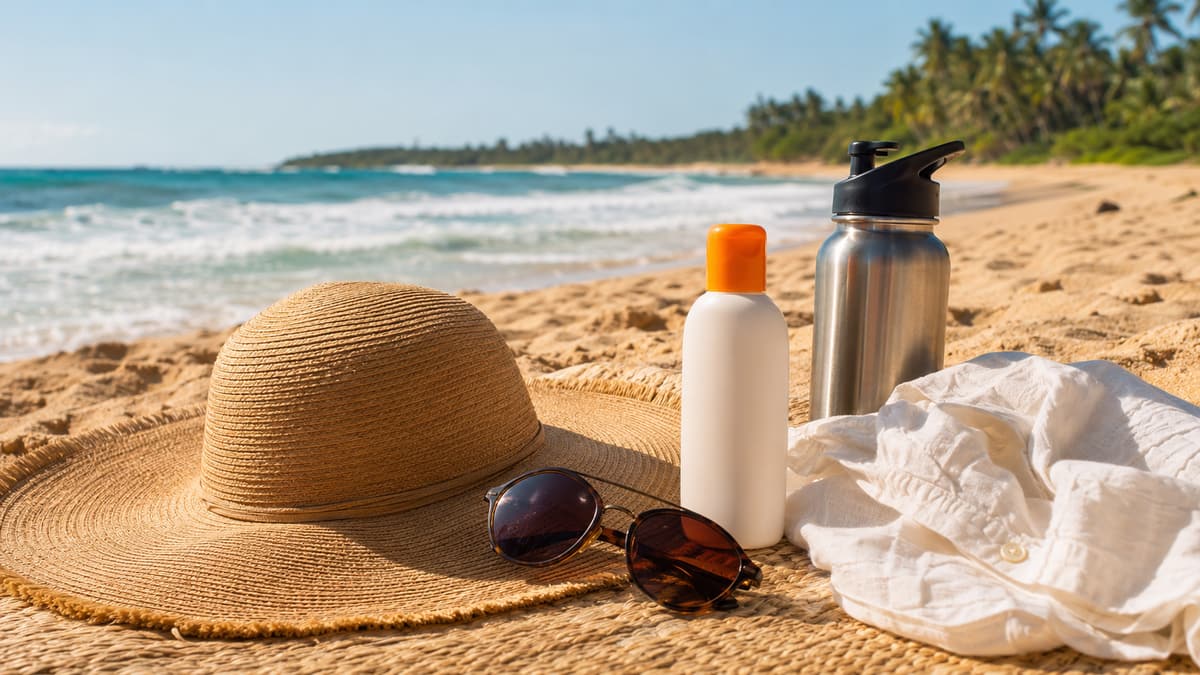
- Zinc-based sunscreen on the face, ears, and the back of the neck, reapplied before each session, not once in the morning
- A cap or surf hat for the scalp and ear tops on flatter, less critical days
- Surfing dawn and late afternoon sessions when UV is lower, and treating the midday hours as a break rather than a badge of honour
- Sunglasses with UV protection to reduce the squinting that speeds up wrinkling and protects your eyes from pterygium
Related reading
- Sunburn Treatment and Aftercare in Arugam Bay: What Actually Helps
- Sun Protection and Heat Illness on Sri Lanka’s East Coast
- Fungal Skin Infections in Arugam Bay: Recognising and Treating Them
This article is general health information and not a substitute for medical advice. If you’re worried about a mole or skin change, walk in any time or call 1990 for emergency transport.
Related articles
Traveler Health
Allergic Reactions & Anaphylaxis in Sri Lanka: What to Do
New foods, new insects, new sun exposure — Sri Lanka has plenty of new allergy triggers. Here's how to spot a reaction early and what to do if it turns serious.
6 min read

Traveler Health
Altitude Sickness in Sri Lanka's Hill Country: Ella, Nuwara Eliya, and Adam's Peak Day Trips
Planning a day trip to Ella, Nuwara Eliya, or an overnight climb of Adam's Peak from Arugam Bay? Here's what altitude actually does at these heights.
7 min read

Traveler Health
Ant Bites in Arugam Bay: Fire Ants, Red Ants, and What Actually Helps
Small red ants and fire ants are everywhere in beach huts and on sandy paths here. Here's why the bites burn so much, how to treat them, and when a reaction needs a doctor.
6 min read